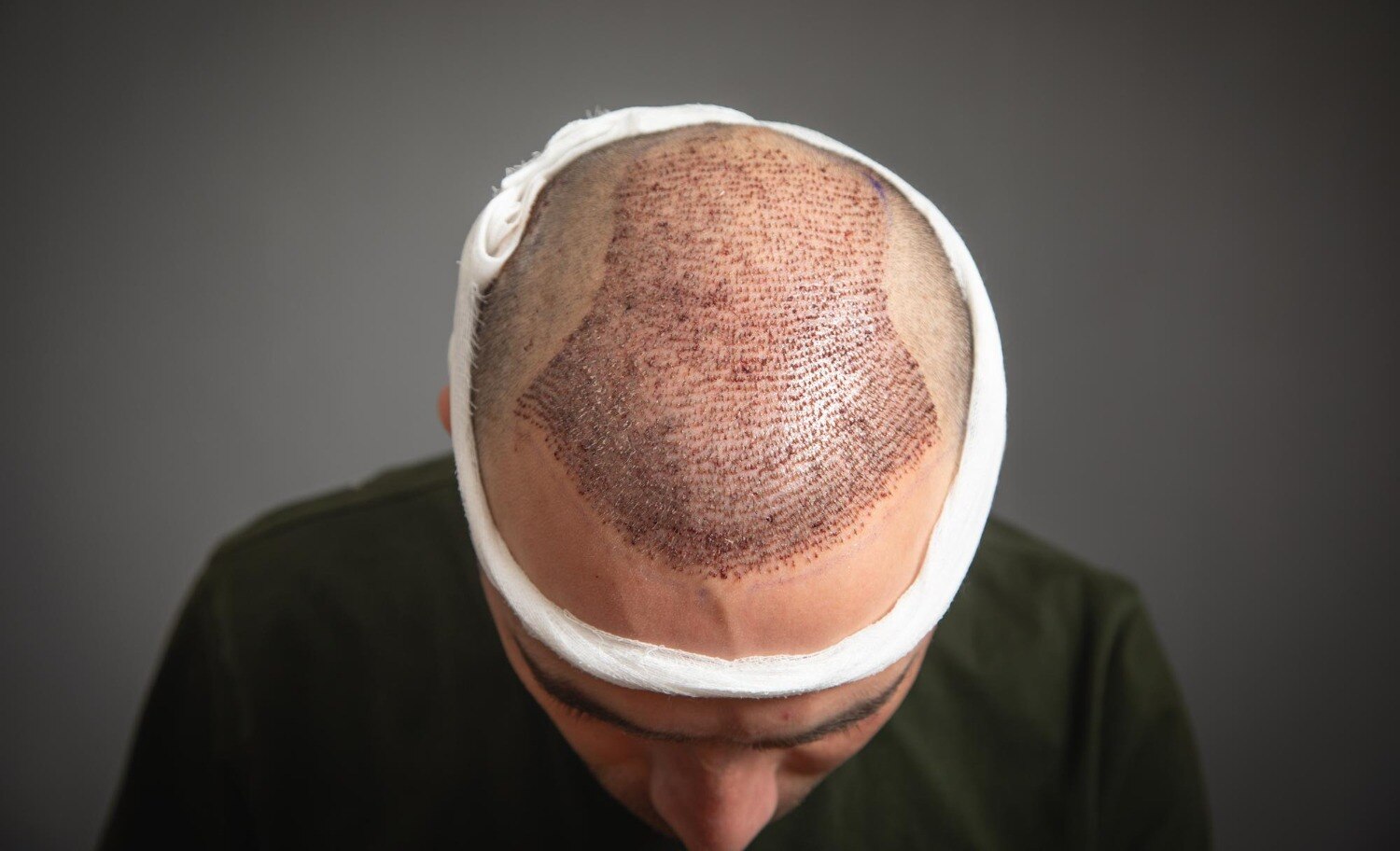
Hair loss becomes a transplant question when shedding does not settle, scalp exposure progresses, and the underlying cause is known. By the end, you will be able to distinguish temporary loss from likely permanent pattern baldness, understand what makes a donor area usable, and compare surgery with treatments that preserve existing hair.
Key takeaways
- Investigate hair loss that persists, recurs, or exposes more scalp.
- Get a diagnosis before deciding whether transplant surgery is suitable.
- Stable donor hair limits how much thinning a transplant can cover.
- Choose treatment or observation when surgery cannot address the cause.
When hair loss is persistent enough to investigate
Persistent hair loss deserves assessment when shedding continues for several months, returns in repeated episodes, or causes visible scalp exposure. A widening part, receding hairline or thinning crown matters more than the number of hairs you notice on a pillow.
- Diffuse shedding that begins after an illness, major stress, weight loss or childbirth points toward telogen effluvium, which can improve after the trigger resolves.
- Gradual recession at the temples, reduced density at the crown or a widening part fits pattern baldness more closely.
- Smooth, sharply defined patches suggest alopecia areata rather than ordinary pattern loss.
- Hairline thinning beneath tight braids, extensions, ponytails or coverings suggests traction alopecia; ongoing pulling can cause permanent damage.
- A new medicine can cause medication-related shedding. Do not stop it without asking the prescriber.
- Scale, redness, pain, pustules or scarring indicate scalp disease that needs medical evaluation before surgery.
Timing, distribution and scalp symptoms reveal more than counting individual hairs. Women and men can both develop conditions that need treatment before a transplant is considered, particularly unexplained diffuse loss or inflammation. A transplant is mainly considered for permanent, non-scarring pattern baldness after the cause and future progression have been assessed.
Why a diagnosis must come before a transplant decision
1. A diagnosis must come before a transplant decision because transplantation suits permanent, non-scarring loss—not every bald or thinning area. During a scalp examination, the clinician should inspect the donor area, map the pattern and rate of loss, and look for scale, redness, pain, pustules, smooth patches or scarring.
Ask about family history, illnesses, recent dieting, hormonal symptoms, medicines, supplements and repeated shedding episodes.
2. Tests should follow the history and examination rather than function as a blanket panel. A complete blood count can help identify anaemia; ferritin can assess iron stores; thyroid-stimulating hormone can investigate thyroid dysfunction; and vitamin D testing may be considered when symptoms or risk factors justify it. Unexplained diffuse shedding deserves investigation before surgery.
3. Treat the cause before discussing grafts. Diffuse shedding, alopecia areata, inflammatory scalp disease, nutritional deficiency and medication-related loss need cause-directed care, while a transplant redistributes follicles rather than creating new ones.
Active scarring alopecia is a poor surgical setting because inflammation can destroy existing and transplanted follicles; selected patients are usually considered only after medical inactivity has lasted at least 1–2 years.
Who has enough stable donor hair for coverage?
A transplantable bald area is not enough: you need enough stable donor hair at the back and sides of the scalp to supply the thinning region without exhausting future options. Stability, not age or sex alone, determines suitability.
A proper donor assessment checks:
- Donor density: how many healthy follicular units occupy a measured area, and whether extraction can provide useful coverage.
- Hair calibre: thicker shafts create more visual coverage than fine shafts from the same number of grafts.
- Distribution: thinning or miniaturisation throughout the back and sides reduces the usable supply.
- Scalp laxity: tighter skin can limit strip-based harvesting and the number of grafts removed safely.
- Likely future loss: the pattern and speed of recession or crown thinning must fit a long-term plan.
The Norwood-Hamilton pattern helps describe male-pattern recession and crown loss, but it does not prove that surgery is suitable. Women with diffuse thinning across the donor zone may have less usable supply even when the front looks sparse. Active, rapidly progressing androgenetic alopecia can leave native hair disappearing around grafts.
Younger patients need particular caution: a low hairline can consume grafts later needed for recession or crown coverage. A suitable candidate has enough donor reserve for durable, planned coverage—not merely a bare area where grafts could technically be placed.
What surgery can restore—and what it cannot
A transplant redistributes existing follicles; it does not create new ones. You cannot reliably regain original adolescent density, and a low hairline can consume grafts needed when native hair loss progresses. Hair colour affects the contrast between hair and scalp, while finer hair usually provides less visual coverage than thicker hair.
Limited donor supply makes planning more important than a promised graft count. Prioritise coverage in this order:
- Hairline, to restore facial framing without designing an unnaturally low line
- Mid-scalp, when thinning behind the hairline reduces overall coverage
- Crown, where a large area can absorb grafts with less visible improvement
Donor density, hair calibre, distribution, scalp laxity and the likely extent of future loss determine how far that plan can go.
FUE and FUT involve different trade-offs:
| FUE | Removes individual follicular units; generally avoids a linear strip scar | Leaves many small wounds and can overharvest or visibly thin the donor area |
|---|---|---|
| FUT | Removes a strip of scalp | Leaves a linear scar but can permit a larger session for selected patients |
Neither technique is scar-free or universally superior. The better choice depends on donor characteristics, scalp laxity, hairstyle and surgical goals.
Transplanted shafts commonly shed during the first few weeks, so early loss does not prove failure. Visible regrowth develops gradually; assess the cosmetic result around 9–12 months, with crown growth sometimes taking longer. Expect improvement, not a return to an untouched scalp.
When treatment or no surgery makes more sense
A transplant redistributes existing follicles; it does not create new donor hair or stop androgenetic loss in untreated native follicles. Choose it only after comparing the coverage you want with the supply available and the time, recovery and risks involved.
| Option | What it does | Main trade-off |
|---|---|---|
| Topical minoxidil | Helps preserve or improve existing follicles | Requires continued use and cannot replace follicles in a bald area |
| Finasteride or dutasteride | May slow androgenetic loss after a clinician reviews suitability and risks | Neither fills a completely bare area, and treatment requires ongoing review |
| PRP or low-level light therapy | Treats thinning follicles without surgery | Neither creates an unlimited donor supply or guarantees regrowth |
| Scalp micropigmentation | Creates the visual effect of closely shaved stubble | It does not produce hair or restore density |
| Hair system | Covers loss without surgery | It needs fitting, cleaning, replacement and ongoing maintenance |
| No treatment | Avoids procedures, medication and recovery | Hair loss can continue and make later planning harder |
Medical stabilisation makes more sense when loss is active, diffuse or rapidly progressing, especially in a younger person whose future pattern is unclear. A consultation with Dr Nakul Somani can help a Jaipur patient compare stabilisation, donor availability, graft goals and surgical risk before choosing.
Be wary of guaranteed results, unlimited donor hair and completely scarless claims. Bleeding, infection, numbness, folliculitis, cysts, poor graft growth, shock loss and donor-site depletion remain possible.
Related services
Hair Transplant in Jaipur The Ultimate Guide to Hair Transplant: A Life-Changing Solution for Hair Loss and Confidence Restoration Hair loss is a deeply personal experience... View service → |
Hair Transplant Get Hair Restoration Done Successfully at Engrace Clinics with Follicular Unit Transplantation (FUT) Follicular Unit Transplant or profoundly known... View service → |
Frequently asked questions
When is hair loss persistent enough to investigate?
Seek assessment when shedding continues for several months, returns in repeated episodes, or causes visible scalp exposure such as a widening part, receding hairline, or thinning crown.
Why must diagnosis come before a hair transplant decision?
Hair loss can have different causes, and a transplant does not treat every cause. Diagnosis helps determine whether the loss is stable and whether another treatment should come first.
Who has enough stable donor hair for coverage?
Candidates need a sufficiently dense, stable donor area—usually at the back and sides of the scalp—to supply grafts without creating unacceptable thinning there.
What can a hair transplant restore, and what can it not do?
A transplant redistributes existing follicles to improve coverage in selected areas. It cannot create unlimited density, restore follicles that no longer exist, or guarantee that future hair loss will stop.
When might treatment or no surgery make more sense?
Choose treatment or observation when hair loss is still changing, the cause needs medical management, donor hair is inadequate, or the expected coverage does not justify surgery.